
EmDash: a CMS built for 2026
The way we build software changed forever at the end of 2025. Suddenly our AI agents went from smart auto-complete to actually being able to develop software. We stopped writing boilerplate and started describing intent. But the tools we build with haven’t caught up, especially content management systems. Most CMSes were designed for a world where humans click through admin panels, plugins run with full trust, and deployment means uploading files to a shared host.
That world is gone. And today Cloudflare launched something built for the one we’re actually in. And no, despite it being April 1st, it’s not a joke.
EmDash is the most interesting thing to happen to content management in years. Not because it’s built on Astro (though it is), but because it’s the first CMS designed from the ground up for how we work in 2026: AI agents building sites, structured content that machines can parse and manipulate easily, and deployment at the edge.
What EmDash actually is
EmDash is a full CMS built on Astro. End-to-end TypeScript. Deploys to Cloudflare Workers, Netlify, or Vercel. SQLite locally, Cloudflare D1 in production. Images on disk or R2/S3.
But the tech stack isn’t the point. The design philosophy is.
Every architectural decision in EmDash seems to have been made with the same question: “What if an AI agent needs to do this?” Content is stored as portable text — structured JSON, not HTML strings — which means an agent can read, modify, and generate content without parsing markup. Custom content types get their own database tables with typed fields, so an agent can reason about the schema programmatically. There’s an MCP server for direct CMS interaction, a CLI that outputs JSON, and documentation specifically structured for AI consumption.
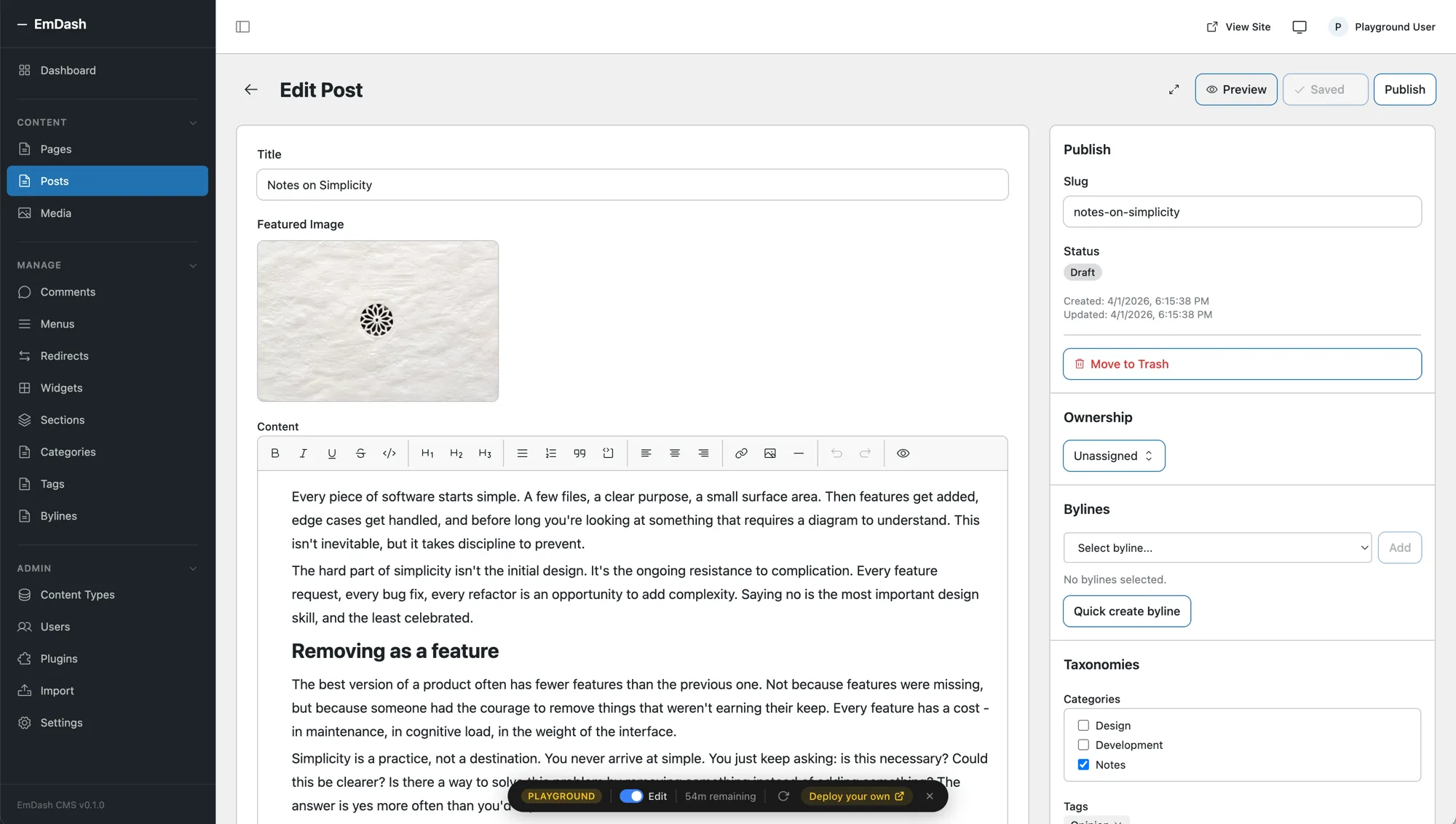
Editing happens on the frontend. You see your actual site while you edit it, not a disconnected admin panel (though you can edit there too). Internationalization is built in from day one. So is redirect management, full-text search, and core SEO functionality.
And it looks a lot like WordPress, which will make people moving over feel right at home. There’s even a complete guide for porting WordPress themes, with mapping tables from WordPress template tags to EmDash API calls that are practically designed to be fed to an AI agent.
The plugin security model is the real story
Any CMS lives or dies by its plugin ecosystem. The challenge has always been balancing extensibility with security: the more a plugin can do, the more damage a bad one can cause.
EmDash takes a fundamentally different approach. Each plugin runs in an isolated worker environment with granular permissions. A plugin has to explicitly request access to content, network calls, or specific APIs. The UI layer is defined through a JSON schema similar to Slack’s Block Kit, which means plugins can’t inject arbitrary HTML or JavaScript into the admin.
There’s a plugin marketplace too, though currently API-only. Submissions go through automated security scanning powered by Workers AI, with Llama Guards handling content classification. It’s not perfect — automated scanning never catches everything — but it’s a meaningful layer of protection built into the platform from the start. And if you’re a WordPress plugin developer, there’s a guide for porting plugins that maps WordPress hooks and APIs to their EmDash equivalents.
What I think is genuinely strong
It’s agent-native, not agent-compatible.
Most CMSes are bolting on AI features — a chatbot here, a content generator there. EmDash is different: the entire architecture assumes AI agents are first-class users. The MCP server means Claude, Cursor, or any agent can create content types, manage entries, configure plugins, and deploy — all programmatically. The CLI outputs JSON. The documentation is structured for machine consumption. Round-trip markdown support means you can export content, edit it in any tool (or let an agent edit it), and import it back without loss. This isn’t an AI feature. It’s an AI-native CMS.
The AI site generation shows where this is heading.
EmDash includes a playground that spins up full sites from a prompt: theme, content structure, sample data, all generated by models running on Workers AI. Today it’s a demo tool. But it shows the trajectory: describe what you want, get a working site. That’s not a gimmick when the entire CMS is structured data an agent can manipulate.
Authentication uses passkeys by default.
No passwords to leak, no brute-force attacks to defend against. Combined with pluggable SSO and built-in role-based access control, the security posture is strong out of the box.
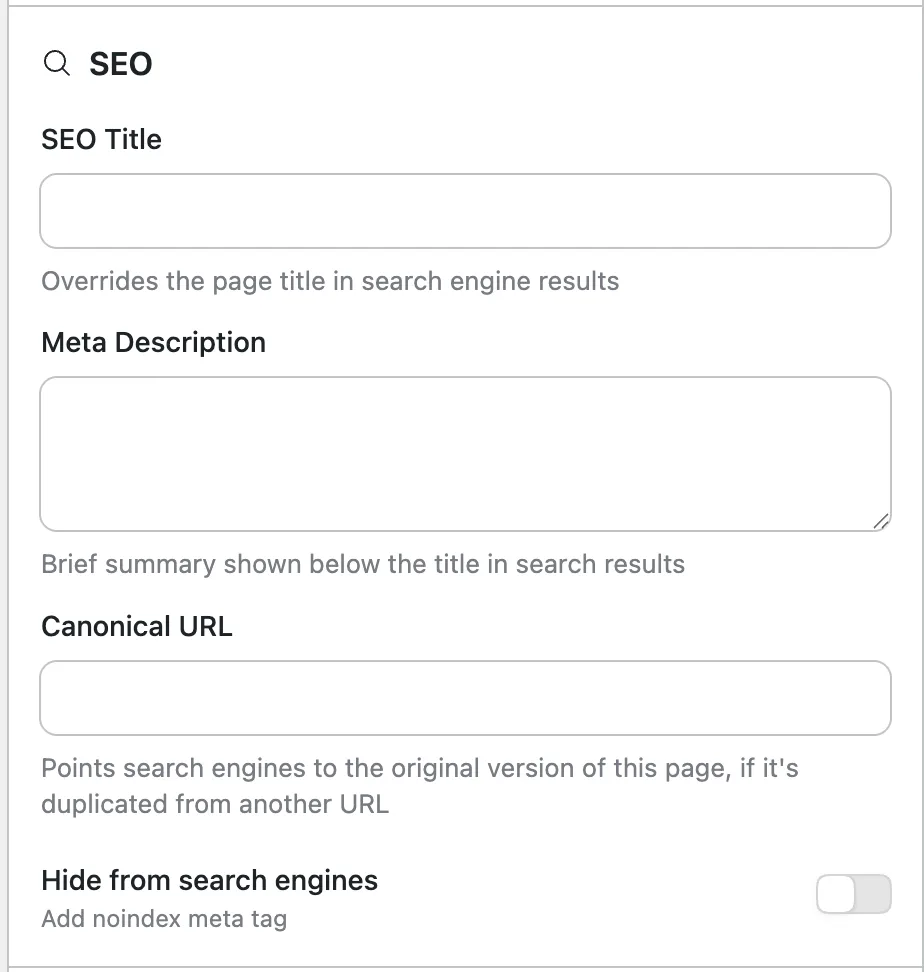
The SEO foundation is solid.
Built-in SEO controls, metadata hooks for plugins, structured content that search engines can parse cleanly. It’s not a full SEO suite, but the architecture makes it straightforward to build one.
What’s still unproven
Let’s be honest about the challenges.
EmDash was built over two months using AI coding agents. That’s remarkable speed, and it shows what’s possible when you build on a modern foundation like Astro without decades of legacy to navigate. But a CMS is a long-term commitment, and two months of AI-assisted development is not the same as two months of battle-testing in production. The real test starts now.
The plugin ecosystem is empty. WordPress has over 60,000 plugins. EmDash has a marketplace architecture but no community yet. History shows that CMS adoption is driven more by available plugins and themes than by technical merit. Ghost, Craft, Statamic; all technically excellent, none have built the ecosystem needed for broad adoption. EmDash will need to solve that same chicken-and-egg problem.
The open-source story needs clarity. It’s MIT-licensed, which is great. But it’s still a Cloudflare project, and developers will want to see long-term governance commitments before investing their time.
Deployment is flexible: one click deploys to Cloudflare Workers, Netlify, or Vercel, and it’s supported on any modern hosting platform. That said, the Cloudflare integration is the most polished (D1 for the database, R2 for storage), and it’ll be worth testing the other hosts to see how well the multi-platform story holds up in practice.
Why I’m going to build on it
Every CMS generation reflects the tools used to build with it. WordPress was shaped by FTP, PHP, and shared hosting — and it shows. Squarespace by drag-and-drop visual builders. The next generation will be shaped by AI agents, and the CMS that wins will be the one those agents can work with most effectively.
That’s what EmDash gets right. Structured content an agent can read and write natively. A typed schema it can introspect. An MCP server it can talk to directly. A plugin system with clear boundaries it can develop within safely. This isn’t a CMS with AI features added on top. It’s a CMS where AI is a first-class builder.
When I moved this blog to Astro, I thought I’d left CMSes behind. Then I spent an evening building an EmDash theme for this site and started migrating content — because a CMS that an AI agent can build on this naturally is hard to resist. But the bigger picture is agencies building client sites, creators who need multi-user workflows, anyone building more than a static site. For them, a CMS isn’t optional. The question is what a good one looks like when your primary development partner is an AI agent.
EmDash is my answer. It’s built on Astro, deploys to Cloudflare, and adds the CMS layer with the kind of architecture I’d design if starting from scratch: sandboxed plugins, structured content, TypeScript throughout, edge deployment. But what seals it is that I can point Claude at it and say “build me a theme”, and the structured documentation, typed APIs, and MCP server mean it actually can.
I’m planning to develop on and with EmDash, and I’ll share more about what I’m building as it takes shape. For now, go look at EmDash and form your own opinion. The launch is today, and regardless of where it ends up, it’s asking the right question: what should a CMS look like when AI agents are doing most of the building?


Comments